


Most ECC to S/4HANA projects take 15 to 20 months from kickoff to go-live, and a quarter run longer than two years. That means a mid-size company that hasn’t started yet is unlikely to finish before SAP’s end-2027 mainstream maintenance cutoff. The practical goal now is a plan that keeps ECC supported until you go live, with 2030 as the realistic outside date.
How long does an S/4HANA migration usually take?
The best numbers come from SAP user group surveys, not vendor brochures:
- ASUG’s 2026 research (194 members) found the average project takes about 1.4 years to go live. Brownfield conversions averaged 15.8 months. Greenfield reimplementations averaged 20.2 months.
- SAPinsider’s July 2025 benchmark put the average deployment at around 18 months. A quarter of respondents expected their project to run past two years.
- ASUG’s 2024 survey saw a range from four months to six years.
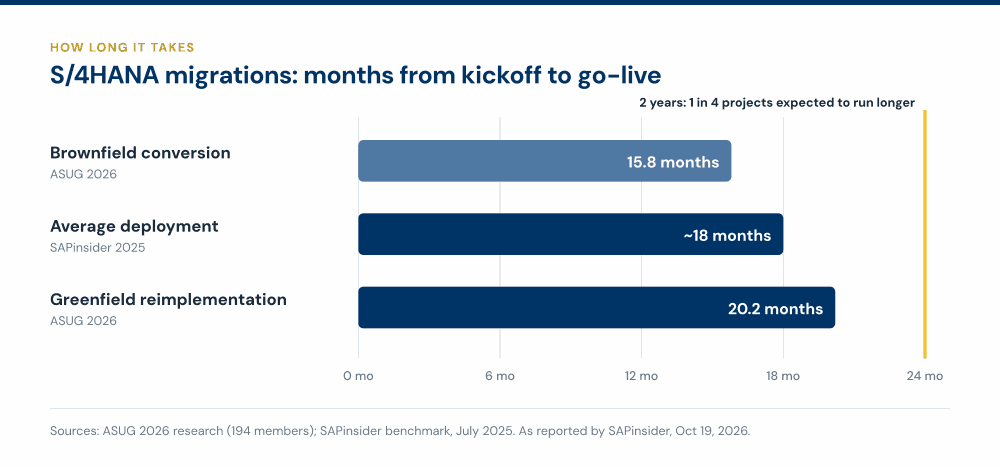
Those averages start at kickoff. They don’t include the months most companies spend building a business case, choosing a path and picking an implementation partner before the project clock starts.
What makes a migration take longer?
Scope sets the length. The usual drivers:
- Custom code. Fifteen years of Z-programs and user exits all need to be found, tested and fixed or retired.
- Interfaces. Every connection to MES, EDI, banks, tax engines and warehouse systems has to be rebuilt or retested.
- Master data. Customer and vendor records must move to the business partner model. Dirty data adds cleanup time.
- Path choice. Brownfield (converting your current system) is usually faster. Greenfield (starting clean) takes longer but lets you redesign processes.
- Your own people. The person who knows how your month-end close really works is also running month-end. Backfill matters.
- Enhancement package level. Systems below EHP 6 may need an upgrade first just to stay supported.
Is it too late to finish before the end of 2027?
For most companies that haven’t kicked off, yes. SAPinsider’s math is simple: an average-length project started now finishes in early 2028, after mainstream maintenance ends. Its research also found that projects already underway will likely finish by end-2027, while companies still building a business case likely won’t.

That isn’t a crisis. It means you need a bridge.
What keeps you covered while you migrate?
Here’s how SAP’s dates line up:
- December 31, 2025: Mainstream maintenance ended for SAP ERP 6.0 on EHP 0 to 5. No extended maintenance is offered for those releases.
- December 31, 2027: Mainstream maintenance ends for SAP ERP 6.0 on EHP 6, 7 and 8.
- 2028 to 2030: Optional extended maintenance for EHP 6 to 8, at two percentage points on top of your maintenance basis. Without it, you move to customer-specific maintenance, which is much more limited.
- 2031 to 2035: SAP ERP, private edition, transition option. This is a cloud subscription, not on-prem maintenance. In November 2026, SAP extended it to the end of 2035. To qualify, systems must move to SAP ERP, private edition before the end of 2030, run on SAP HANA and be at least 2 TB, and the Max Success Plan is required.
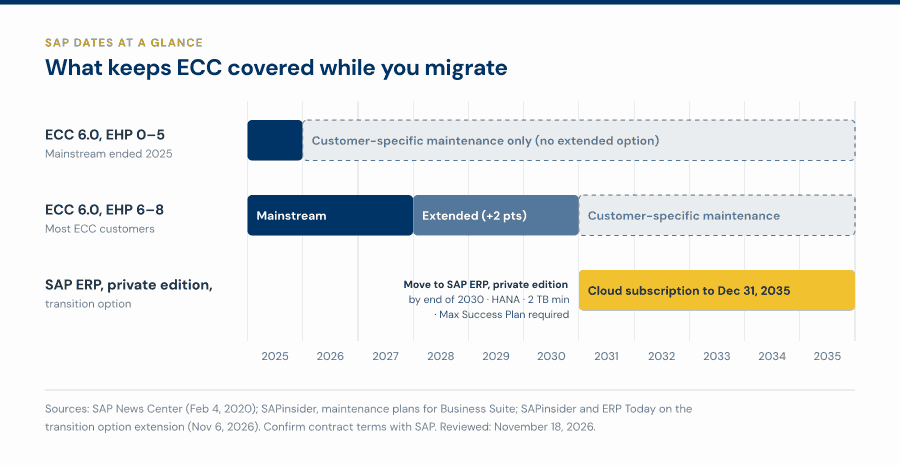
For most mid-size ECC customers, the working bridge is extended maintenance through 2030.
Where are you today? A quick decision table
| Where you are today | Realistic target | What to do next |
|---|---|---|
| Project underway, go-live set before late 2027 | 2027 is possible | Protect the date. Plan hypercare and who supports you after go-live. |
| Business case approved, no partner chosen | 2027 is tight | Pick a partner now. Budget extended maintenance as a backup. |
| Haven’t started | Go live by 2030 | Run SAP’s Readiness Check, confirm your EHP level, and make the path decision in 2027. |
| On EHP 5 or lower | Already out of mainstream maintenance | Decide between an EHP upgrade to stay supported or moving straight to S/4HANA. |
| Large, complex landscape headed to RISE | Possibly 2035 via the transition option | Check the 2 TB minimum and SAP Note 3591251 for eligible products. |
What to do this quarter
- Confirm your release and EHP level for every ECC instance, not just production.
- Run SAP’s Readiness Check. SAP’s guidance is to run it in production, in the productive client. It shows simplification items, custom code impact and add-on compatibility.
- Inventory interfaces and custom code. Count them. They’re one of the best early signs of how long the project will run.
- Price extended maintenance into the 2028 budget, even if you hope not to need it.
- Name your internal team and plan backfill for the people who will be pulled into the project.
- Decide who keeps ECC running. The migration will absorb your best SAP people. Someone still has to close the month and fix the tickets.
- Set a decision date. Brownfield, greenfield or RISE, and which implementation partner, by mid-2027 at the latest if 2030 is your target.
How FirstCall helps
Our SAP consultants average more than 20 years of experience. We work with ECC teams in three ways:
- Before the project: we help you confirm your EHP level, extended maintenance eligibility, custom code and interface picture. See our S/4HANA and ECC 2027 page.
- During the project: our SAP managed services team keeps ECC stable so your people can focus on the migration. If you need an EHP upgrade first, our projects and enhancements team can scope it.
- The migration itself: S/4HANA migrations are delivered with implementation partners we’ve worked with for about 20 years, and FirstCall keeps the ongoing support relationship after go-live.
Not sure where your timeline really stands? Get the ECC 2027 Reality Check.
FAQ
How long does an ECC to S/4HANA migration take?
Typically 15 to 20 months from kickoff to go-live. ASUG’s 2026 research found brownfield conversions averaged 15.8 months and greenfield projects 20.2 months. A quarter of projects in SAPinsider’s research were expected to exceed two years.
Is brownfield faster than greenfield?
Usually. Brownfield converts your existing system, so configuration and history come along. Greenfield takes longer because you redesign processes, but you leave old custom code behind.
Can we still go live before the end of 2027?
If your project is already underway, possibly. If you haven’t kicked off, plan on extended maintenance through 2030 as your bridge.
What happens if we’re still on ECC after 2030?
Extended maintenance ends December 31, 2030. After that, on-prem ECC drops to customer-specific maintenance. The SAP ERP, private edition, transition option runs to 2035, but only for qualifying systems moved to SAP’s private cloud before the end of 2030.
Does extended maintenance cost more?
Yes. SAP charges two percentage points on top of your maintenance basis for 2028 to 2030. Confirm the terms for your contract with SAP.
Sources: SAPinsider, “SAP S/4HANA Migration Timelines: The Average, the Range, and the Factors Behind Both” (Oct 19, 2026), citing ASUG 2026 and 2024 research and SAPinsider benchmark reports (July 2025; ERP Migration and Transformation 2026); SAPinsider, “SAP Details End of Maintenance Plans for Business Suite”; SAP News Center, “SAP Extends Its Innovation Commitment for SAP S/4HANA” (Feb 4, 2020); SAPinsider, “SAP Extends ERP Private Edition Transition Option to 2035” (Nov 6, 2026) and ERP Today (Nov 2026); SAP Community, SAP Readiness Check FAQ. Confirm contract terms with SAP before acting. Reviewed: November 18, 2026.
